India is adding solar and wind capacity rapidly, but renewable generation changes with weather and time of day. Solar output falls after sunset, while wind generation varies with weather conditions. This creates a need for storage that can shift electricity from periods of surplus generation to periods of higher demand.
Pumped hydro provides one such solution. It moves water to an upper reservoir when electricity is available and releases it through turbines when power is needed. In India, pumped storage projects can broadly be classified as on-stream (open-loop) and off-stream (closed-loop) systems. Their connection to natural water sources affects site selection, environmental considerations, land requirements and approvals.
How Pumped Hydro Energy Storage Works
Pumped hydro energy storage works like a large water-based battery. When electricity is available in surplus, pumps move water from a lower reservoir to an upper reservoir. When electricity is required, the stored water flows back through turbines to generate power.
This allows electricity generated during periods of high solar or wind output to be shifted to periods when renewable generation is lower. Global pumped storage capacity crossed 200 GW in 2025, according to the International Hydropower Association.
Key Differences Between Open-Loop and Closed-Loop Pumped Hydro Designs
In India, pumped storage projects can broadly be understood based on their connection with natural water sources:
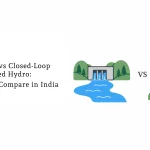
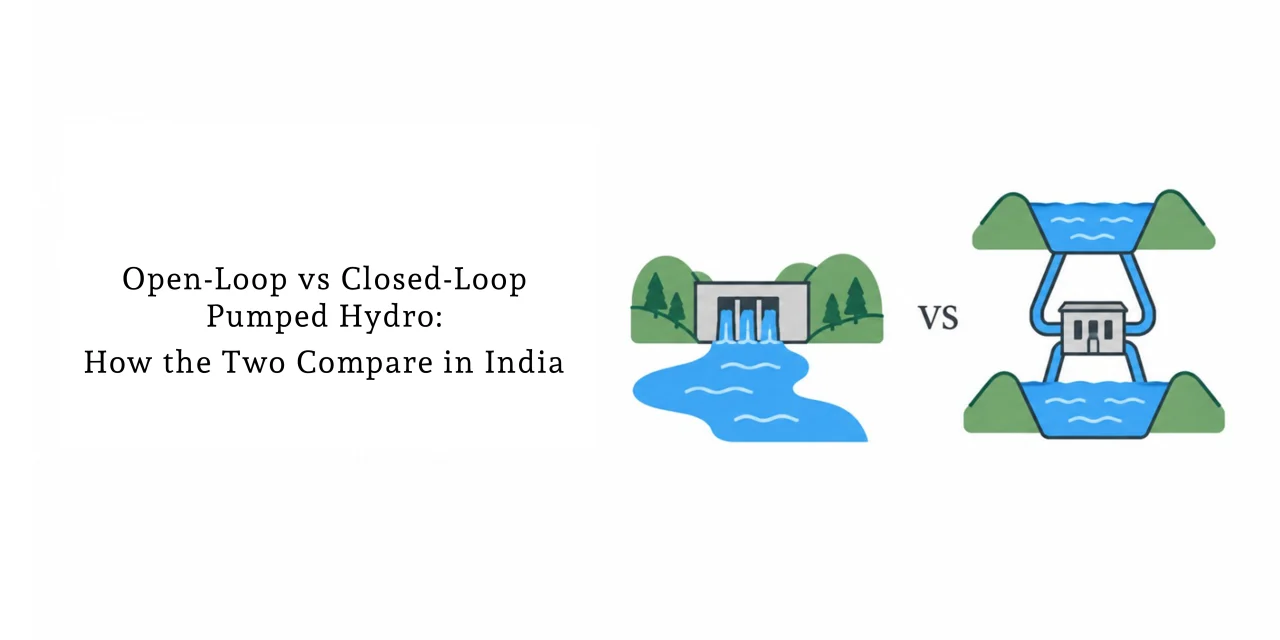
- On-stream projects: Connected to a river or existing reservoir and using a natural water body as part of the system wherein both the reservoirs are located on any river/stream/nallah. It can be termed as the open-loop scheme.
- Off-stream projects: Out of the two reservoirs of the scheme:
1. None of the reservoir is located on any river/perennial stream/perennial nallah which is termed as off-stream closed loop project,
2. One of the reservoirs is located on any river/stream/nallah,which is termed as an off-stream open loop project.
India has identified around 337 GW of pumped storage potential, including approximately 54GW of on-stream and 283 GW of off-stream potential.
| Parameter | Open-Loop | Closed-Loop |
| Water connection | Connected to a river or existing reservoir | Not directly connected to a naturally flowing water source |
| Reservoirs | Uses an existing water body as part of the system | Uses purpose-built upper and lower reservoirs |
| Water use | Relies on an external natural water source | Mostly recirculates water within the system |
| Site selection | Requires access to a suitable river or reservoir | Can be developed away from natural water bodies |
| Environmental considerations | Greater interaction with rivers and aquatic ecosystems | Less direct interaction with natural water bodies |
| Key considerations | Water use, downstream users and environmental clearances | Land, elevation, water availability and site conditions |
Land, Water and Approvals: How the Choice Plays Out
The project location largely determines which design is suitable. An on-stream plant can use an existing river or reservoir, but its operation can affect water levels, aquatic ecosystems and other users of the water resource.
An off-stream plant keeps its reservoirs separate from naturally flowing water. This can reduce direct interaction with rivers and provide greater flexibility in selecting sites with suitable elevation differences. However, the project still needs sufficient water for initial filling and ongoing losses.
India has also taken steps to facilitate the development of off-stream closed-loop pumped storage projects, including changes to requirements related to Central Electricity Authority concurrence.
What the Choice Means for a Pumped Storage Company
For a pumped storage company, selecting between an on-stream and off-stream design starts with the characteristics of the proposed site. An on-stream project may suit locations where an existing reservoir or river provides the required water connection and elevation difference.
An off-stream project may suit locations where the terrain provides two reservoirs at different elevations without requiring a direct connection to a naturally flowing water body.
Both designs require suitable terrain, stable geological conditions, reservoir locations and a reliable grid connection. Developers must also assess water availability, land requirements, construction conditions and applicable approvals.
Indian clean energy companies, including Avaada Group, are exploring energy storage solutions alongside renewable generation. The underlying purpose remains the same: store electricity when renewable generation is available and supply it when demand increases.
Where India Stands Today
India already has pumped storage projects operating in its power system. About 7.4 GW of pumped storage capacity was operational across 8 projects as on date, according to the Central Electricity Authority.
As solar and wind capacity expands, pumped storage can shift electricity from periods of high renewable generation to periods of higher demand, including evening hours when solar output declines.
Final Thoughts
On-stream and off-stream pumped hydro use the same basic principle: storing electricity by moving water between reservoirs at different elevations. Their main difference is how they interact with natural water sources, which affects site selection, environmental considerations, water requirements and approvals.
On-stream systems can suit locations where existing rivers or reservoirs provide the required conditions. Off-stream systems can offer greater flexibility at sites away from naturally flowing water, provided suitable terrain and water resources are available.
For India, the choice is less about which design is universally better and more about which configuration fits the site, water availability, terrain, grid connection and regulatory requirements of a particular project.