
For many utility-scale solar projects in India, land aggregation and title clearance can take longer than construction. Finding hundreds of contiguous acres, establishing ownership and negotiating access create a development challenge before the build begins.
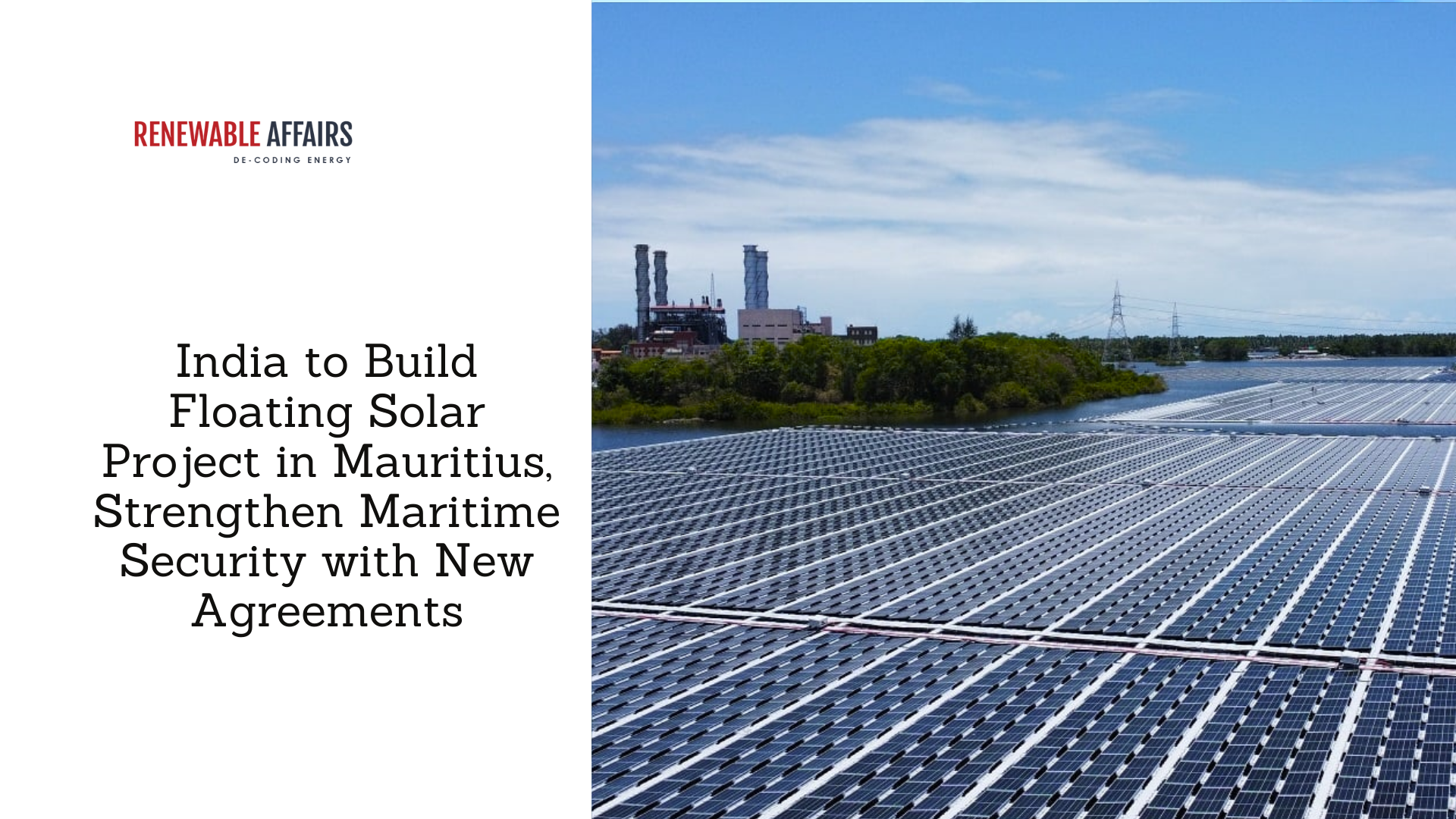
On 31 July 2026 the Union Cabinet approved the Pradhan Mantri Surya Sarovar Yojana (PM-SSY), a scheme for floating solar photovoltaic projects with co-located energy storage. It is intended to use suitable reservoirs, irrigation tanks and industrial water bodies without acquiring the large contiguous land parcels required by ground-mounted solar.
The scheme carries ₹5,070 crore and targets 5,000 MW. Every project has to come with storage attached.
This article covers what the scheme actually contains, what it pays for, and the part most coverage skips: what changes on a project when the plant is built on water.
What PM Surya Sarovar Yojana Scheme Contains
PM-SSY is a Cabinet-approved scheme for developing floating solar photovoltaic projects with co-located energy storage. The figures below come from the official Cabinet release issued on the day of approval.
| Item | Detail |
| Approved | 31 July 2026, Union Cabinet |
| Total outlay | ₹5,070 crore |
| Capacity target | 5,000 MW floating solar photovoltaic |
| Storage requirement | Co-located, minimum two hours, 10,000 MWh across the scheme |
| Sanctioning window | FY 2026-27 to FY 2030-31 |
| Disbursement window | Up to FY 2032-33 |
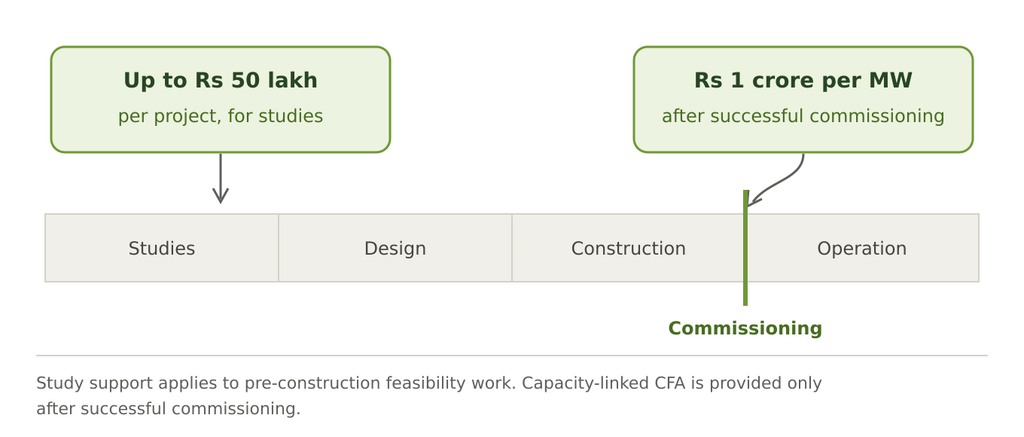
| Capacity-linked CFA | ₹1 crore per MW, after successful commissioning |
| Feasibility-study CFA | Up to ₹50 lakh per project for feasibility studies |
| Coverage | All states and union territories |
| Expected emissions reduction | Around 10 million tonnes of CO₂ per year |
| Expected employment | 16,000 to 17,000 full-time equivalent |
Two numbers explain why the government moved on this. The National Institute of Solar Energy has put India’s floating solar potential at roughly 102.18 GWp. Against that, the country has around 700 MW built and running today.
The 5,000 MW target is about 4.9% of the 102.18 GWp potential cited in the Cabinet release. It is a substantial programme, but only a fraction of the assessed technical potential.
How a Floating Solar Plant is Put Together
The panels are the same panels. Almost everything holding them up is different.
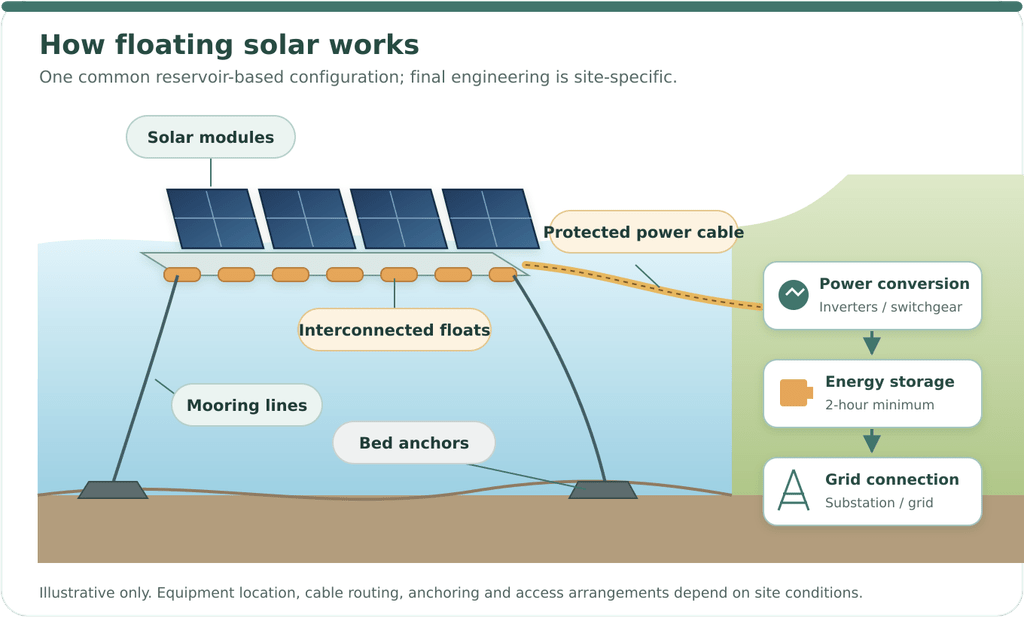
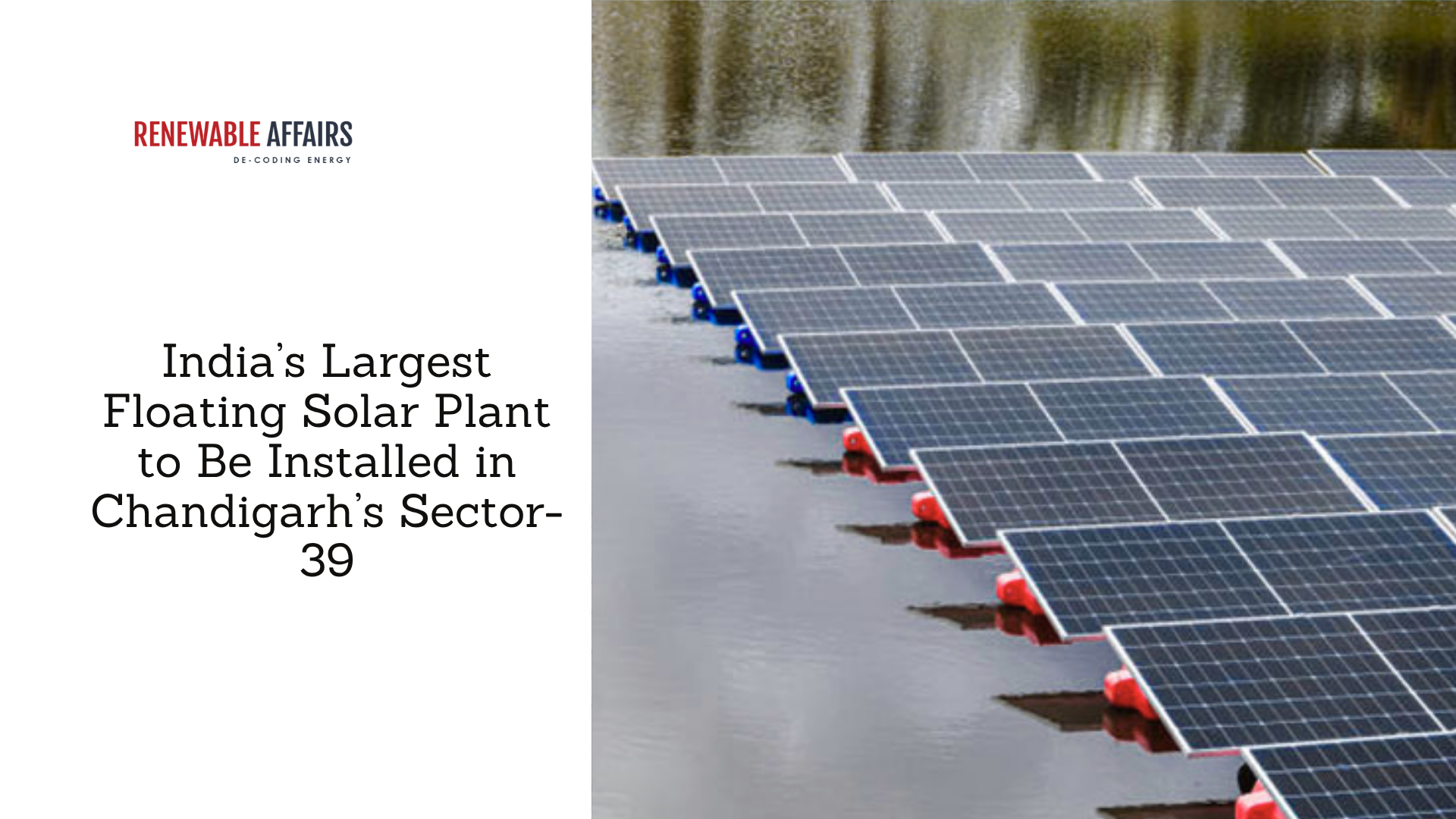
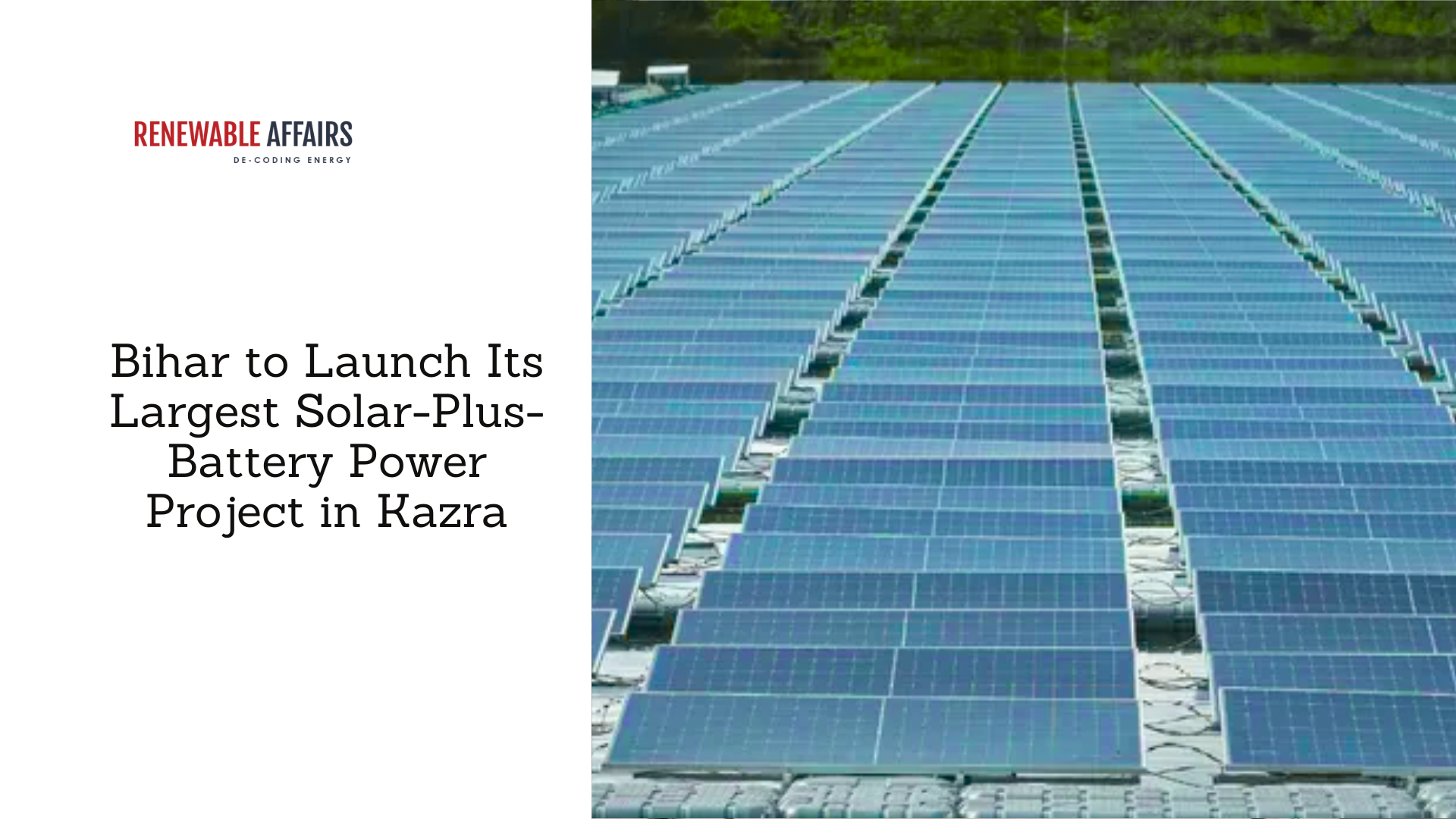
Instead of ground-mounted steel structures, the modules are installed on interconnected floats, commonly high-density polyethylene units assembled into a raft. Depending on the design, the floating system may include dedicated walkways or rely on planned boat access for cleaning and inspection.
The array is held in position by engineered mooring lines connected to anchors on the reservoir bed or bank. Their length, geometry and tension are designed for the site’s water-level range, wind and wave loads, bed profile and operating offsets. In India, short-catenary systems are common; they must be checked carefully because lines can become taut and experience dynamic loads at high-water levels or under movement.
Power leaves the array through protected cables routed on, below or alongside the floating system and then ashore. The location of inverters, transformers and switchgear is site-specific: equipment may sit on the bank, on floating platforms, or in a combination of both. The storage system and grid connection complete the electrical path.
Two things follow from the water that are worth knowing.
The water environment can reduce module operating temperature, which may improve output compared with an otherwise similar land installation. The array can also reduce evaporation by shading part of the surface, although the effect depends on coverage, climate and reservoir conditions. These potential benefits should be confirmed for the site rather than treated as guaranteed.
What Surya Sarovar Yojana Scheme Actually Pays For
Support comes through two separate channels, and they work differently enough that it is worth reading them apart.
₹1 crore per MW, after successful commissioning.
An eligible 50 MW project would correspond to ₹50 crore of capacity-linked assistance, subject to the detailed scheme guidelines and successful commissioning.
The operative word is after. This assistance is not upfront construction finance: the capacity-linked CFA is paid only after successful commissioning. Developers will therefore need to plan construction funding and delivery risk before receiving the support. The assistance may improve project economics once the plant is operational.
Up to ₹50 lakh per project for feasibility studies
This is the smaller number and the more interesting one.
This support is available for feasibility work before final design and construction, including bathymetry, hydrography, environmental studies and other preparatory work intended to de-risk the project.
Bathymetry means mapping the bed of the reservoir. Depth, slope, obstructions, what the bottom is made of. Hydrography covers how the water behaves across the year: how far the level falls, how quickly it rises, how much sediment moves through it.
Both investigations feed directly into anchoring and mooring design. Incomplete bed or water-level data can lead to an unsuitable layout, with corrections becoming more difficult and expensive during installation.
Providing separate support for feasibility studies recognises that site investigations are central to de-risking a floating solar project before major capital is committed.
Why Storage is Compulsory
Every project under the scheme must include co-located storage with a minimum of two hours. Across 5,000 MW that comes to 10,000 MWh.
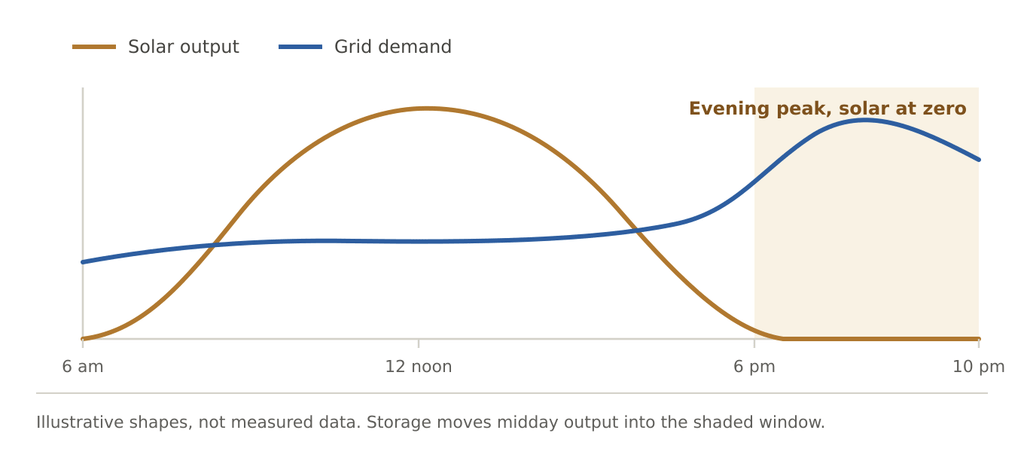
The reason sits in the shape of the day.
A typical solar generation profile rises after sunrise, peaks around the middle of the day and falls towards sunset. Electricity demand follows a different and variable profile; in many periods, evening demand remains high after solar output has declined. The chart below is illustrative rather than a measured national load curve.
The operational constraint is already material. Between April and June 2026, 8,133 GWh of available solar output was curtailed or restricted, according to a Rajya Sabha reply citing Grid Controller of India data: 2,417 GWh in April, 3,235 GWh in May and 2,481 GWh in June. The stated reasons were grid security and a mismatch between the commissioning of renewable projects and associated transmission infrastructure.
During curtailed or restricted periods, a project may lose generation revenue while financing and operating costs continue.
Storage addresses the timing part of the problem by shifting some midday generation into later delivery periods, subject to dispatch and offtake arrangements. It does not add capacity to a constrained transmission corridor, so the connection point still remains a central site-viability question.
PM-SSY makes a minimum two-hour, co-located storage requirement explicit across the full 5,000 MW programme, equivalent to 10,000 MWh of storage capacity.
What Changes When the Plant is on Water
This is where a floating project stops resembling a ground-mounted one, and it is worth being specific, because these differences drive schedule, cost and risk.
| Ground-mounted | Floating |
| Geotechnical soil investigation | Bathymetry and hydrography survey of the reservoir |
| Piled or ballasted foundations | Anchoring and mooring design sized for seasonal level change |
| Cable trenching across the site | Site-specific protected cable routes on or below water, then ashore |
| Equipment placed across the plot | Equipment may be split between floating platforms and the bank |
| Land lease or purchase | Permission to use the water surface, from whichever body owns it |
| Vehicle access for O&M | Boat and/or designed walkway access, depending on the layout |
| Wind loading on structures | Wind loading plus wave action and level variation |
A few of these deserve more than a table row.
The survey informs core design decisions. On a ground-mounted project, the soil investigation informs foundation design. On water, bed profile, ground conditions and seasonal water-level variation shape the anchoring and mooring system, which is one of the project’s largest engineering risks.
Additional rights and stakeholders. A floating project needs both a viable grid connection and permission to use a water surface controlled by an irrigation department, generation company, municipal body, industrial operator or another authority. Those approvals may involve different entities and timelines, so neither should be assumed.
Maintenance access should be planned at design stage. Walkway width, boat landing points, module height and cleaning routes are set by the array layout, and retrofitting safe access later can be difficult and costly.
Who May Participate Under the Sarovar Scheme
The Cabinet release says all states and union territories are expected to benefit. The programme targets 5,000 MW in aggregate, but individual project-size limits and applicant eligibility have not yet been published.
Until detailed eligibility and allocation rules are published, likely participants or site-owning entities include:
- State generation companies and power utilities, which hold reservoirs behind hydro stations
- Central and state public sector undertakings, including thermal stations with cooling reservoirs or ash ponds that may offer candidate surfaces, subject to technical and environmental studies
- Independent power producers and project developers, subject to the eligibility, allocation and offtake rules in the detailed guidelines
- Irrigation departments, municipal bodies and industrial operators holding tanks, ponds and treatment lagoons
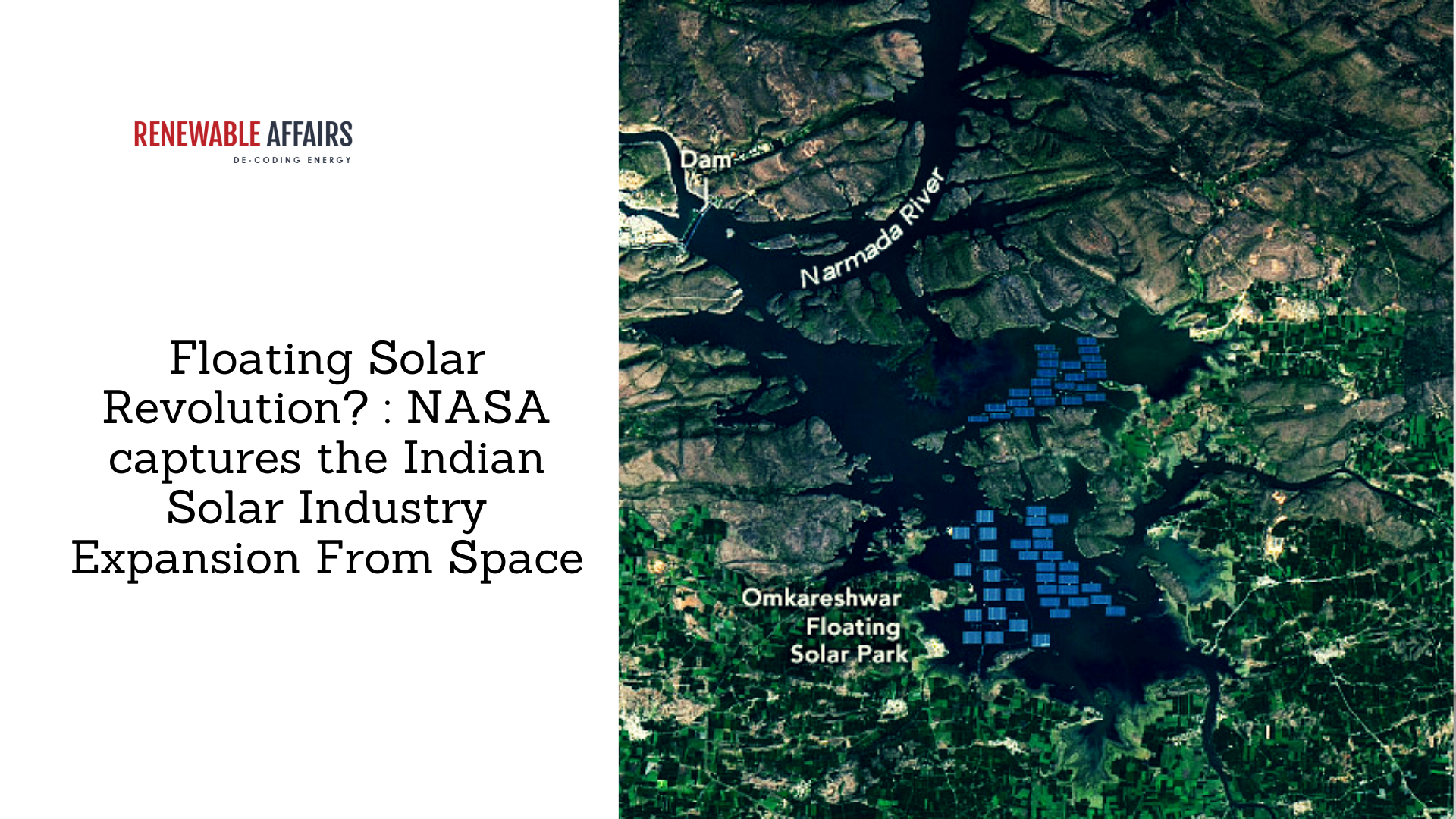
Ramagundam in Telangana shows how the thermal-station route can work. NTPC developed a 100 MW floating plant on the balancing reservoir of an existing station through a BHEL EPC contract; it became fully operational in July 2022 at a reported project cost of ₹423 crore. At Omkareshwar in Madhya Pradesh, 278 MW had been commissioned as of January 2025 against a planned 600 MW, through projects involving Rewa Ultra Mega Solar, NHDC, AMP Energy Green and SJVN.
What Has Not Been Decided Yet
Being clear about this is more useful than filling the gap with assumptions.
The Cabinet approval sets the outlay, the capacity target, the storage requirement, the assistance rates and the timeline. Detailed scheme guidelines from MNRE have not yet been published. That means the following are not yet settled in the public domain:
- Eligibility criteria and who may apply
- The bidding or allocation mechanism, and which agency runs it
- Minimum and maximum project sizes
- Tariff structure and offtake arrangements
- Domestic content requirements, and how existing approved list rules will apply
- The process for securing rights over a water body
Some of these points may be described elsewhere as settled, but they are not in the Cabinet release. Any final application process should be treated cautiously until official detailed guidelines are issued.
For anyone with a water body in mind, useful early work includes identifying the controlling authority, checking environmental and operational constraints, understanding seasonal water levels, and assessing nearby grid capacity. Available grid capacity can be as decisive as usable water area.
Where to start
The scheme provides separate CFA for feasibility studies and capacity-linked CFA only after successful commissioning, underlining the importance of early site investigation. A reservoir that looks obvious on a map can still fail on bed profile, drawdown, sediment, environmental constraints or the distance to a connection point with available capacity.




























































































































































































































































































0 Comments