
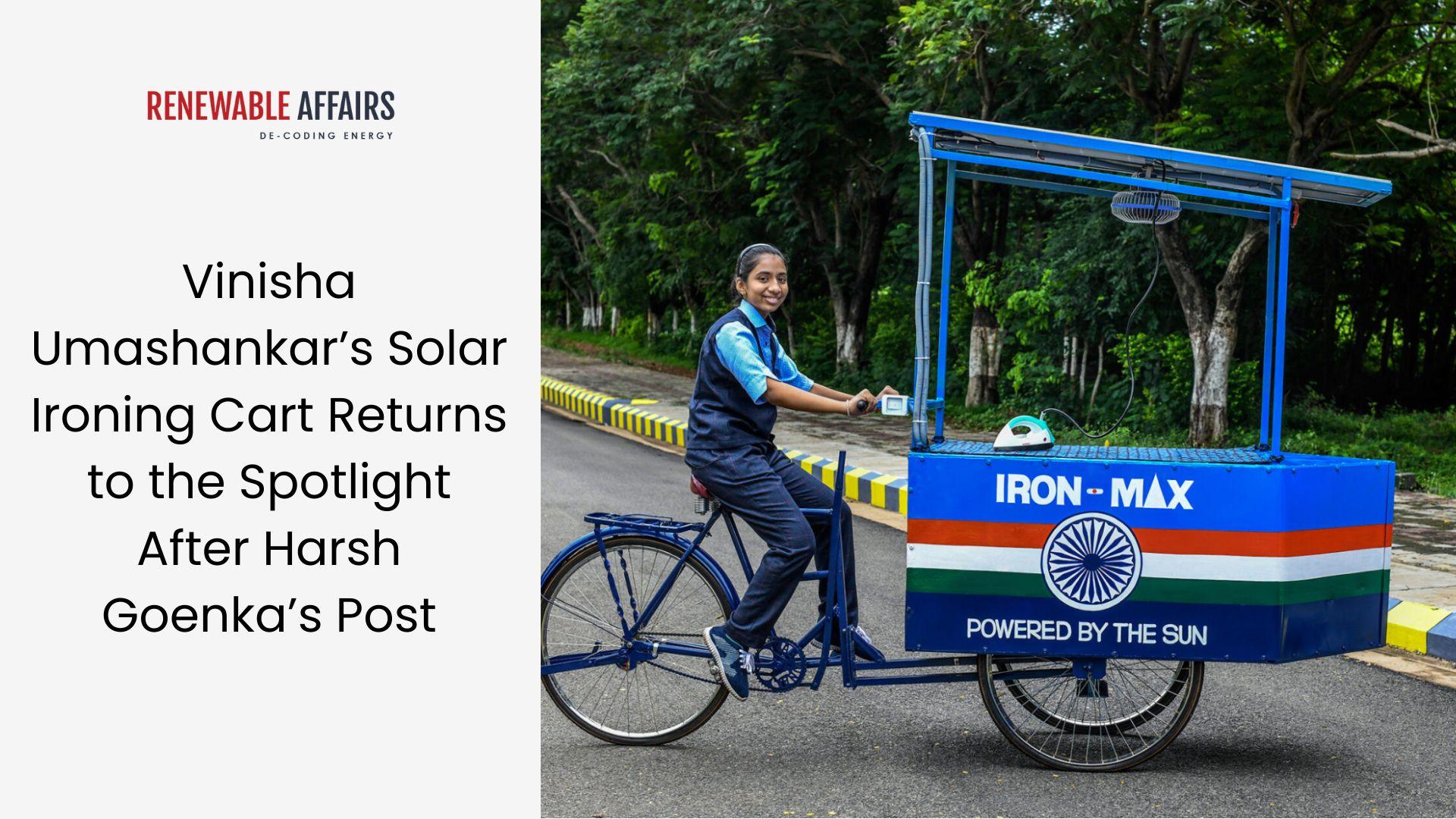
The Tamil Nadu innovator developed the cart as a cleaner alternative to charcoal-fired irons used by roadside vendors. Her journey later took her to the Earthshot Prize and the COP26 stage with Prince William.
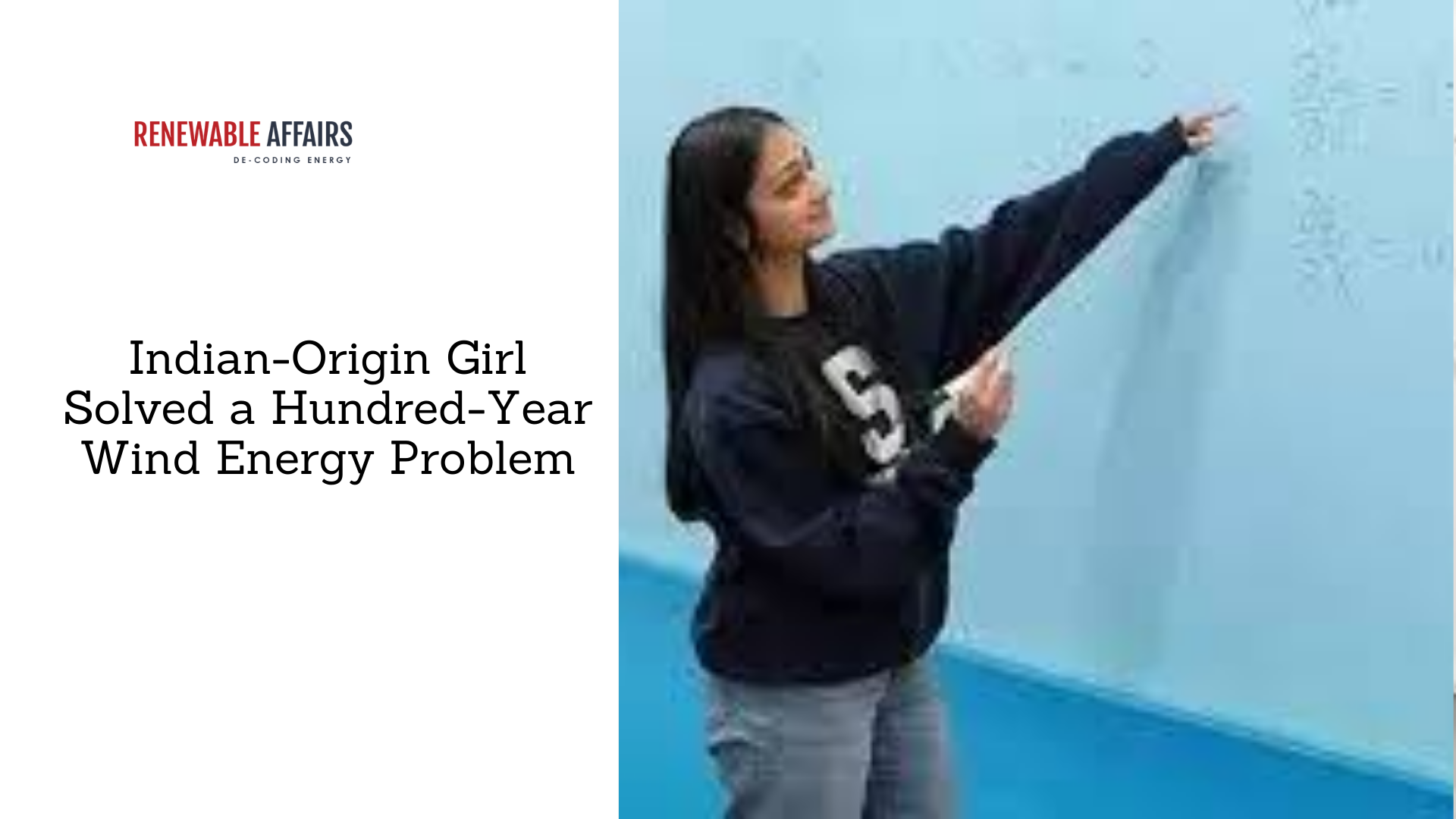
Vinisha Umashankar’s solar-powered ironing cart is once again drawing public attention after industrialist Harsh Goenka shared her story on social media in June 2026. The innovation itself is not new; the recent post has revived interest in a journey that began in Tamil Nadu and later reached major international climate platforms. The Economic Times reported on the renewed attention.
Vinisha, who is from Tiruvannamalai, developed the idea after observing the charcoal used by roadside ironing vendors and the burnt fuel left behind after use. She began looking at whether the same work could be done with a cleaner source of energy.
Her response was a mobile ironing cart fitted with solar panels and a battery-based power system. The electricity generated by the panels is used to operate a steam iron, while stored power can support work when direct sunlight is limited.
How the solar ironing cart works
According to the National Innovation Foundation–India (NIF), the cart can use solar power to run a steam iron and can also operate through pre-charged batteries or an external electricity source when sunlight is unavailable. Its central purpose is to eliminate the need for charcoal while retaining the mobility that allows vendors to serve customers at their doorsteps.
The Earthshot Prize profile of Vinisha states that roughly five hours of sunshine can provide enough energy for about six hours of ironing. The design also includes mobile-phone charging facilities, which could create an additional income opportunity for a vendor.
The idea matters because it applies distributed renewable energy to an everyday livelihood rather than a utility-scale project. For vendors, such a system could reduce exposure to charcoal smoke and dependence on fuel purchased for daily use.
From a local observation to international recognition
Vinisha received the Dr. A.P.J. Abdul Kalam IGNITE Award in 2019 for the idea. NIF later developed a prototype of the solar ironing cart and supported technology development. NIF’s November 2021 update records the project’s development and her subsequent appearance at COP26.
In 2021, she was selected as a finalist in the inaugural Earthshot Prize under the “Clean Our Air” category. She was the youngest finalist in that year’s cohort. The prize was founded by Prince William to identify and support solutions to major environmental challenges. Earthshot’s official finalist page lists her as a finalist—not as one of the five winners.
COP26 speech and meeting with Prince William
Vinisha’s association with the Earthshot Prize took her to the COP26 climate summit in Glasgow in November 2021. At age 15, she addressed a session on accelerating clean-technology innovation and deployment before an audience that included international leaders and Prince William.
Her speech called on decision-makers to move beyond promises and support young people already working on climate solutions. Contemporary reporting also documented her appearance with Prince William at the summit. The Indian Express covered the COP26 address and their appearance together.
The moment helped move the solar ironing cart from a student innovation into a wider global conversation about youth-led climate action. It also showed how a small solution developed around a common Indian livelihood could gain attention on an international platform.
A continuing role in climate and innovation
Vinisha later served as a UNICEF India Youth Advocate for the term from May 3, 2024, to May 2, 2025. Her areas of interest included innovation, climate change and encouraging girls’ participation in science, technology, engineering and mathematics. UNICEF India’s profile provides the official term and focus areas.
Why the story remains relevant
The renewed attention around Vinisha’s work is not tied to the launch of a new product. Its relevance lies in the continuing discussion around how decentralised renewable-energy systems can support informal workers and small businesses.
Unlike a large solar park or rooftop installation, the cart was designed around one routine activity: ironing clothes. That makes it a useful example of how the energy transition can reach individual livelihoods through small, purpose-built technologies.
At the same time, the next phase of the story depends on questions that remain publicly unanswered: whether the cart has moved into commercial production, what it costs, how it is financed, how easily it can be serviced and how many vendors are using it today. Fresh answers to those questions would determine whether the project is best understood as an award-winning prototype or as a scalable clean-energy business.
For now, Harsh Goenka’s post has brought an earlier innovation back into public view and renewed interest in a young inventor whose work travelled from the streets of Tiruvannamalai to the global climate stage.
Sources and recommended external links
• National Innovation Foundation–India: Solar Ironing Cart — Primary technical source for how the cart works and its intended benefits.
• National Innovation Foundation–India: COP26 update — Primary institutional source on prototype development, the IGNITE Award and COP26.
• The Earthshot Prize: Vinisha Umashankar — Primary source for finalist status, category and performance claims stated by Earthshot.
• UNICEF India: Vinisha Umashankar, Youth Advocate — Primary source for her Youth Advocate term and advocacy areas.
• The Indian Express: COP26 coverage — Contemporary report on her speech and appearance with Prince William.
• The Economic Times: renewed attention in 2026 — Secondary source for the current news hook linked to Harsh Goenka’s post.


































































































































































































0 Comments